
A Bit of History, a Dash of Philosophy, and a Definition or Two

As mentioned above, the term “performative” or “performativity” was popularized by the philosopher Judith Butler, whose work on gender performativity can be seen as one of the catalysts, if not the catalyst, for Queer Theory as a field of study. Butler was influenced by the work of philosopher J. L. Austin, particularly his book How to Do Things with Words, published in the mid-twentieth century.
In How to Do Things with Words, Austin describes what he calls performative sentences or performative utterances: “the uttering of the sentence is, or is a part of, the doing of an action, which… would not normally be described as, or as ‘just’, saying something” (5). In other words, in saying the thing, you also actually do the thing. The classic example which Austin provides is that of making a promise: in saying “I promise,” you not only say it, but also do it. It is both a speech and an action, and the action is performed by the speech.
Butler, then, takes Austin’s understanding of performative speech and applies it to sex/gender: “[s]uch [gendered] acts, gestures, enactments, generally construed, are performative in the sense that the essence or identity that they otherwise purport to express are fabrications manufactured and sustained through corporeal signs and other discursive means” (185). That is, certain acts and embodiments of gender, when continuously enacted and re-enacted, make up our genders: there is no core or center of gender; it is merely constructed and expressed through our actions and representations. In doing gender, as with invoking a performative speech, gender comes into existence.
This is, admittedly, a far reach from the popular understanding of performativity. Performativity, in the current lexicon, seems to imply some sort of conscious action taken to achieve a certain goal: the guy in the coffee shop who performatively reads feminist literature to attract women is making a conscious choice to gain a result; same with the girl on TikTok who boasts of reading Tolstoy but puts down War and Peace after the first 200 pages. For Butler, gender performativity is almost unconscious—it’s ingrained in our minds, and we do it without thinking: in a crowded space, a woman may unconsciously maneuver herself to take up less space; a man might unconsciously stifle certain emotions, even when a particular situation calls for it. Gender performativity is something that we carry into our most intimate spaces and selves, whereas this new kind of performativity is specifically a performance for other people: I think of people who specifically tailor their listening habits to have a specific top artist on their Spotify Wrapped so that they look a certain way when they post it on Instagram.
Increasingly, the things that we do—the music that we like, the clothes we wear, etc.—say something about us as people: our values, interests, and what type of category we fit into, to the point where my listening to a CD is not seen as a mere thing that I like to do, but puts me in a particular box of person. It restricts our ability to be fully fleshed-out individuals, and has become labelling shorthand. Twenty years ago, listening to CDs was something everyone did, but now it signals something about me with the implication that I’m doing it in order to be seen doing it.
Physical Media and the Analog Trend

If your algorithm is anything like mine, you’ve been bombarded with videos like “things to do to get off your phone” or “what’s in my analog bag.” The Analog Trend has been floating around for a while now, and I definitely got sucked into it. The irony is not lost on me: showing an offline lifestyle to an online audience—performing being “offline” has become a kind of status symbol as we increasingly cannot do anything without our phones. It signals something about you as a person when you’re able to read a physical book rather than scroll through social media for hours on end.
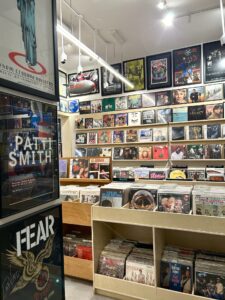
At first this trend was appealing—I already had a stack of unused journals in my drawer, and I’ve been collecting vinyls for about eight years now, and the encouragement to use those things was definitely needed. That being said, the consumerist nature of the trend quickly became apparent to me. If you’re not somebody who already had all that stuff, then you had to go out and buy it in order to go “analog.” And once you go out and buy it, then what? You actually have to use it? To be “offline,” you have to use it and then not film yourself using it, but if you use it and no one sees, then what’s the point? If a tree falls in a forest and no one’s there to hear it, does it even make a sound? It has left a bitter taste in my mouth.
A few years ago, I had a friend who bought a record player, and she admitted that she bought it because of me. Not because I told her to, but because I “inspired” her to do so. I should have been flattered, but I admit that it felt a bit like she was stealing my swag—like she was being performative about it, because I could never picture her actually using it (though I’m sure she did). I feel like that person who sees you wearing a Pink Floyd t-shirt and asks you to name five of their songs. I don’t like being that person, and I don’t like being cynical about what might be a genuine attempt at engaging with music or any media in a different, non-algorithmically induced way. If anything, I should be excited that all this stuff is coming back—so why aren’t I?
First of all, there’s the consumerism of it all. Secondly, the environmental impact of all that consumerism is not negligible: it’s not hard to see landfills filling up with vinyls and plastic CD cases in the future (my colleague Dana McCallum wrote about that here). Thirdly, it just… doesn’t feel authentic. It’s a subjective feeling, of course, but I just don’t buy that all the people on social media who purport to do these things actually do so when the cameras aren’t rolling. That being said, I am a fan of physical media, and if there’s one thing I would like to do, it’s encourage people to actually engage with media in that way, whether it’s music, movies, or anything else, without performing it, because I think the benefits are substantial.
The Substantial Benefits
Phenomenology, as a method of literary analysis, generally posits that “[a] literary work may be produced and published, but how it is received as much determines what it is and what it means” (Rivkin and Ryan 298). I would extend this to all forms of media, meaning that the way a piece of media is interacted with helps construct its meaning in the mind of the person interacting with it. I want to highlight the word interacting right off the bat, because I believe that actively interacting with a piece of media, rather than passively consuming it, is an essential part of engagement. It’s one thing to put some music on in the background while doing chores, but it’s another thing to actually listen to the instrumentation and lyrics and comprehend what is being communicated. To the point, though, I would argue that the format in which we interact with our media—let’s take music as an example—is crucial to our understanding of it.
When I listen to music on a streaming service, I am more inclined to skip songs that don’t interest me or aren’t my favourite. On vinyl, though, that’s not possible. You actually have to listen to the whole thing, front to back and side to side. The same is true with CDs. Even though I can technically skip songs on a CD, I am less inclined to do so due to the nature of the medium. Many albums contain instrumentals or interludes that I tend to skip past when I’m casually listening. But these tracks still add something to the overall meaning and sonic theme of the album. In this way, it actually changes my experience and understanding of the artwork I’m interacting with; my brain is able to play with the material differently.
As another personal, non-music example, let’s talk about magazines. I can get free access to digital copies of magazines through my local library, but when reading these magazines on my phone, I felt a strange sense of urgency that caused me to skip past articles that didn’t interest me. But once I started buying physical copies of the magazines I like, I found myself actually reading every single article—that sense of urgency disappeared, and I was able to engage with the material more holistically, and I found meaning and insight in articles I would have previously skipped over. In this way, as Phenomenology contends, the way I interact with a piece of media literally changes my experience of it.
Another, perhaps more sentimental benefit of physical media is that physical media can tell stories in ways that digital media can’t. I borrowed a CD of the Eagles’ Greatest Hits from my grandfather (the Eagles is his favourite band). When I downloaded it onto my phone and listened to it later, all the tracks ran smoothly except for “Hotel California,” which was totally scratched up and unlistenable. This, then, was the track that he played the most—this tells me something about him and his relationship to the music, which connects me to both my grandfather and the music itself in a new and interesting way. This connection over time and space could not have happened if I’d just listened to the Eagles on streaming.
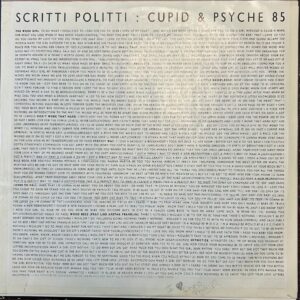
Recently, I was reading a second-hand book, and the previous owner had left notes and underlines on particular passages. I was able to read this book for the first time and gain insight into what a stranger thought about this book, and what passages stood out to them. A similar thing happened with a used vinyl I bought as well: the previous owner had underlined certain lyrics on the sleeve, and had even written “I <3 Chris Phillips” across the bottom. Isn’t that amazing? Again, these types of personalizations change how we interact with media, and they can only be gained through physical objects and representations of media.
Though the recent interest in physical media does strike me as performative, it doesn’t have to be. It can also just be us; the things we enjoy and interact with can fuel us and influence us without saying something about us as people. That doesn’t necessarily mean starting a vinyl or CD collection; it could also just be you picking an artist and sitting back and really listening to an album, front to back, side to side. Reading the lyrics as you go. It could be you asking your friend what their favourite album is and listening to that, and learning something new about them as well—finding out what resonates with them and maybe finding something that resonates with you, as well. Aside from the philosophy and literary theory, there is so much to be gained from listening to an album because you like it and you want to, without allowing an algorithm to dictate the songs that pop up on your playlist. Nothing has to be performed; you can just like things, regardless of their aesthetic value. That is where authenticity lies.