
Last week, New York alternative rock band King Falcon rolled into Toronto for a show at Handlebar on their Summer 2026 Tour, and as a part of NXNE. Fronted by Michael Rubin (vocals, lead guitar) alongside Joe Conserva (bass) and Dipayan “Dip” Chakraborty (drums), the band blends vintage guitar grit with modern 21st-century alt-rock attitude. Fresh off the release of their latest single “Nothing Feels Amazing,” we sat down with them to talk about their music and life on the road. Read the conversation below.
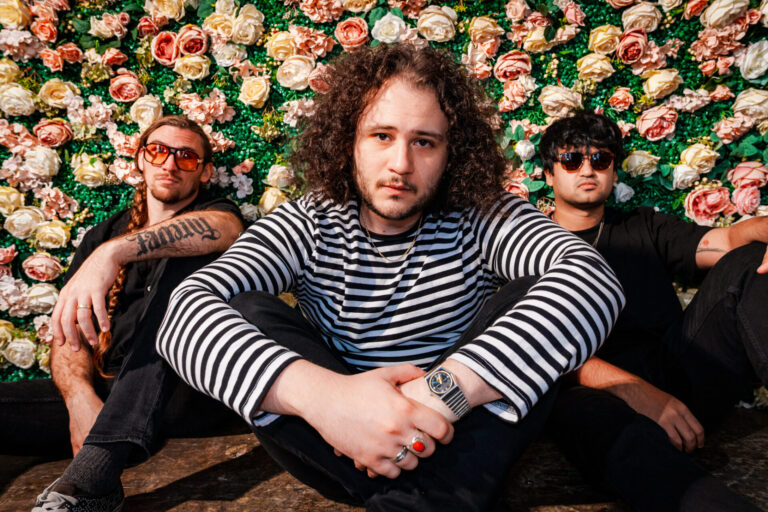
SYHANN: You just released a new single, “Nothing Feels Amazing,” Congratulations! If “Wait” and “Nothing Feels Amazing” were chapters in the same emotional story, what would be the next chapter?
MICHAEL: Well, they definitely are sort of about the same thing – kind of wrote them about the same event and at the same time in my life. What I would like for it to be is the sort of happy return afterward. But it doesn’t always work out that way. So I guess I just need to see what happens in my own life before I go and write a song about it. I don’t know yet.
JOE: To me, those songs are about stages of grief. So I think one of the next stages would be a good motif in the song.
DIP: Yeah, I would probably wait for what happens in Mike’s life.
SYHANN: Your music has roots in classic rock influences. Is there one thing from the old school music industry that you’d love to bring back? And one that you’d like to leave in the past?
MICHAEL: I think if you had asked me this question when I was younger, I was a bit more dogmatic about things being analog and doing it the old way. But that’s not important. The more I’ve written and the more I’ve recorded and learned. If it sounds right, it is right. You know, I don’t think any of us are a fan of the growing use of AI in music. Classic music is sort of the opposite of that, you know, where there’s like little imperfections that make it what it is. And I think it’s important to lean into those rather than try to edit every little thing out.
DIP: I feel like there’s one thing from that era, which is people watching the live shows without the camera or a phone in their hand.
JOE: I definitely enjoy seeing people dancing while they are listening. Not just like watching with their hands crossed. Actually enjoying and being present like Dip said, not on your phone. It definitely makes a difference.
SYHANN: You’ve played a lot of shows in a relatively short amount of time. What’s something about touring that nobody warned you about?
JOE: Increasing gas prices. It’s getting higher and higher.
MICHAEL: I mean, all of it, you know, like you growing up wanting to be a rock star. It’s like wanting to be an astronaut. You just think about being on the moon. You don’t think about getting to the moon, you know. So it’s all the other stuff.
Let me walk you through a regular schedule of a tour day. So you got the three of us and our photographer, Niko, and we’re sharing one hotel room, first of all. So we got to be out of there by 11 o’clock in the morning, which sounds late. Let’s say you’re on the road at 10, 30, 11 o’clock. You drive the whole day. You get to the venue. You got to load in. Usually it’s up a huge flight of stairs and it’s usually raining or snowing or it’s incredibly hot or something like that. You get there. You rush. You hurry up. You do sound check. You wait for the show. You do the show. You drive to the hotel somewhere else because you don’t want to stay in town and have somebody steal your gear because they know what the van looks like. Get to the hotel at three o’clock in the morning. Rinse, repeat.
On one side, it’s nice because it’s really good to have this routine and it’s nice to get into a sort of rhythm. But on the other side, every minute is kind of accounted for. But you also have to sit around and wait for people to come and for the show to start. I love it, but it’s kind of tough to get used to. And I think the toughest thing is when you get back home afterward and that schedule is no longer there and the pace of life is very different.
It’s like being on the highway and like somebody yanking the emergency brake in the car.
DIP: Yeah, everything slows down a lot. You have nothing to do. You’re just chilling, looking at the TV.
SYHANN: Is there something music has taught you that has absolutely nothing to do with music?
JOE: I would say patience, big time. You gotta be willing to sit through traffic and you gotta be willing to hang out. And also being a salesman. In order for a musician to make money, you have to be a T-shirt salesman. I mean, if the music doesn’t sell it, it’s your personality. So you gotta be able to connect with the audience on a personal level and get them to hang around and want to come up to you at the merch table because nobody likes spending money. So coming up to the merch table already is intimidating. Just to be back there ourselves, I think makes it more personable. We get to chat with our fans and our friends, and even if they don’t buy anything, we get to talk to them. And that’s what I think matters the most.
DIP: I learned a lot about respecting the struggle of others, not just me. Every one of us, we’re in the same boat, working towards being somewhere. So that’s a lot of work. And I learned how to respect that. Also, luck is a huge factor into where you go.
MICHAEL: I’m definitely a little bit of the opposite of Joe. I did not learn patience. I’m not a patient person. It’s probably one of my biggest flaws. But I think the biggest thing, maybe not that I’ve learned, but that has impacted me is seeing the reaction of people to the music. Like when you first start doing this and you’re just writing songs in your basement, hoping somebody listens to them, it’s hard to have that sort of grasp of the fact that it’s really out there. But then once you’re touring and you’re meeting people face to face, and they’re talking to you about how the music has affected them and things, you sort of approach it differently and you think about each of the people on the road that you’ve spoken to when you go back and work on the second album. A lot of them are in my head when I’m writing songs. So I think it’s probably changed my perspective more than anything.
SYHANN: What’s part of being in a band that gets easier each time and what somehow never gets easier?
JOE: When we first started getting in and out of the van, and then playing a rock show for an hour, and then going back in the van, it gets cramped, it gets tight. And I learned to stretch before our shows. I learned to be a little bit more limber and prepare my body for the endurance that it needs. That’s definitely something that I think was helpful to learn.
DIP: I feel like the more shows that you do, you get less tense. When I started out, when I used to get up on stage, I used to be very like, “What’s going to happen? Am I going to do something wrong?” But with the more shows that you do, you get less tense.
MICHAEL: The music is kind of the easy part. I feel like the thing that changes is, again, perspective, right? Not that we’re a big band, but we’re bigger than we were a year ago, even two years ago. It’s hard to see exactly where you’re at until you get to a certain point and look around. Because what happens is you’re constantly the smallest fish in an ever-growing pond. So even if you as a fish get bigger, the pond is also getting bigger. And that’s how it should be. Because if you feel like a big fish and you’re not a household name, you’re not. So I think a little bit of experience and being comfortable with the fact that you’re usually going to be the smallest fish. And that’s not a bad thing. If you’re constantly getting into bigger ponds, it means you’re going in the right direction.