
Coyote Makes a World is a long-form musical project from čnaq’ymi (lone eagle), Indigenous musician, storyteller, and educator, and The Forest, a Brooklyn-based cooperative percussion ensemble. The four track album, released on April 10 2026, draws from Coyote stories, reflecting on the current crises of our times: climate change, environmental pollution, and social media addiction, while drawing from long held Indigenous storytelling traditions.
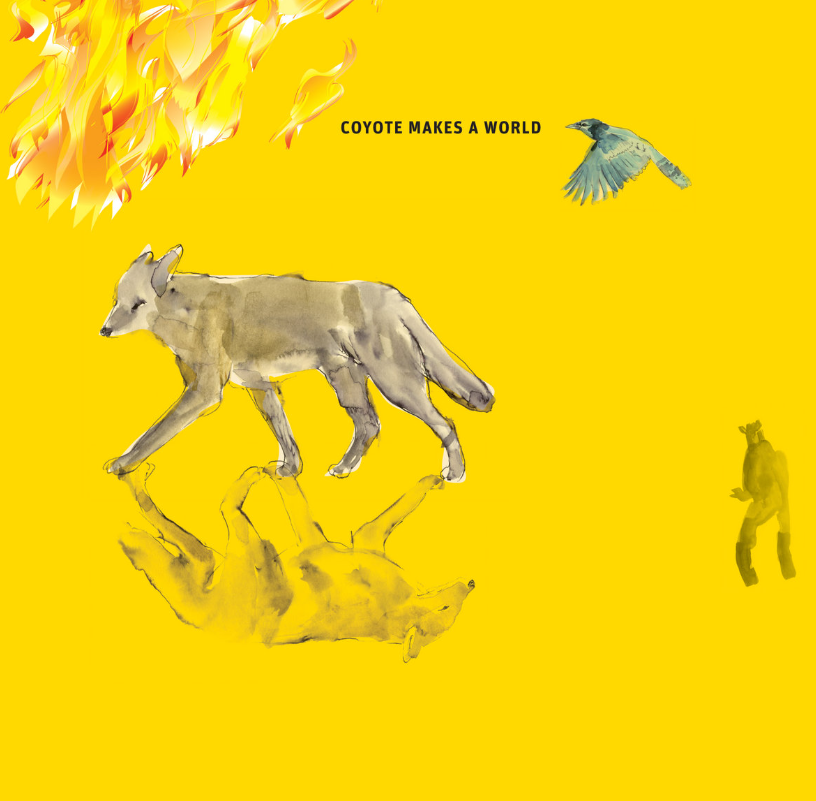
Coyote stories have been in regular rotation within Native communities of the Northwest and throughout Turtle Island (present-day US) for centuries. Within these stories, Coyote (spílye in the Spokane language) embodies a range of undesirable impulses and characteristics, through which Coyote shows his human relatives what not to do. In addition to his many faults, however, he possesses the potential to overcome them, demonstrating qualities to which humankind can aspire.
The album presents the listener with a bleak reflection on each of the three topics: climate change, environmental pollution, and social media addiction. These issues are covered singularly and have their own respective tracks, but are woven together through the journey of Coyote. The first song, “Dancing at Dawn (x̣x̣l̓púleʔxʷ sq̓ʷimncút)” is the shortest on the album, coming in at less than 3 minutes and is instrumental; it introduces the listener to the sonic world of the album.
The remaining three tracks have runtimes from 10-16 minutes each. They are transformative in structure and feature vocalizations, a variety of instruments, and ambient sounds. They move between spoken storytelling and sections of instrumentation and vocals that move the listener through different sonic landscapes as the story of Coyote progresses.
“Sitting on a Song (qʷélm ʔemút)” introduces the listener to Coyote and his ways of excess – reflecting on climate change and the damaging impact humans can have on the Earth. “Coyote was a creature of habit / for many years he walked the Earth / taking whatever he pleased along the way.” Coyote’s excessive ways are introduced, and he is described as self absorbed and oblivious to others. “Eventually, the waterways dried up and the fire-laden winds flattened the landscape (…) / Even though Coyote had walked thousands of miles upon her flesh / he didn’t understand that Mother Earth was responding to his excesses.” The track moves between different rhythmic instrumentation and features atmospheric forest sounds, creating an immersive listening experience.
“Big Belly (kʷtúnt ʔurín)” continues the story of Coyote and reflects on greed and the desire for power, leading to environmental pollution through resource extraction. “Coyote was jealous of Mother Earth / all living things depended upon her / and Coyote wanted that kind of power.” Coyote sets out on a quest to find Mother Earth’s essence and once he does, he laps it up only to end up harming himself and polluting the Earth for 450 years.
The final song, “Black Glass (x̣x̣al̓q̓wáy)” completes the story of Coyote and uses a black piece of obsidian (the “black glass”) as an analogy for cell phone addiction. This track also features the piano prominently, which moves between discordant and harmonious sounds. “One day, he stumbled upon a black piece of obsidian / and when he looked into it, he could see his reflection. (…) The piece of obsidian gave him the power to alter his image, to rewrite his story, and his sorry reputation.” Coyote eventually succumbs to his addiction, thus concluding the story and presenting the listener with a cautionary tale about the current state of the world.
While the reflections on Coyote Makes a World are grim, they are honest. These stories hold up a mirror to our destructive actions that are continuing to impact the environment and ourselves. This project also reinforces the importance of long-form music projects. Listeners are offered the chance to deeply engage with the themes of the project and can be fully immersed in the soundscape created by the artist. Coyote Makes a World gives listeners the chance to reflect and engage with environmental issues through Indigenous storytelling, separate from increasingly negative digital spaces.
Listen to Coyote Makes a World HERE.
čnaq’ymi (lone eagle) is an Indigenous musician, storyteller, and educator dedicated to preserving and sharing the rich musical and cultural heritage of his people. In addition to being a traditional singer in his Spokane tribal community, lone eagle is a north Indian classical vocalist who studied under Pandit Rajeev Taranath, his teacher of 30 years. As a performer, he emphasizes the spiritual and healing qualities of music, weaving age-old practices with contemporary songs and stories that connect deeply with a range of audiences. In addition to his work as an artist, he is a respected scholar in Indigenous studies and an advocate for Indigenous cultural revitalization.
The Forest is a cooperative percussion ensemble featuring Gustavo Aguilar, Leah Bowden, Andrew Drury, and Michael Wimberly—four artists who possess deep experience with collective performing, improvising, and composing, all while in dialogue with a range of African, Asian and Indigenous diasporic practices. Based in Brooklyn, The Forest engages in collaborations, performances, and workshops with diverse communities through the development of newly composed works and the exploration of performance techniques in unconventional physical settings and acoustic spaces.